Stock and commodity markets
Live copies on Hyperliquid's HIP-3 markets for stocks, indices, commodities and currencies. Which markets, what you need, and when an add is skipped.
Besides crypto, Hyperliquid has markets for stocks, indices, commodities and currencies, such as Tesla, gold or oil. They
are called HIP-3 markets. Each one is run on Hyperliquid by a company of its own, the deployer, which sets the
market's price feed and fees and can halt it. syntaka shows such a market with its dex beside its name, for example GOLD
with an xyz tag (xyz:GOLD).
What Hyperliquid lets you trade, syntaka lets you trade and copy. Your live copies follow a trader onto these markets like onto any coin, whenever every check below passes. Cuts, closes and your stop always go.
Which markets
- Every HIP-3 market Hyperliquid has live, on a dex that settles in USDC. There is no list to wait for.
- Each market keeps its home exchange's hours. syntaka knows the hours of every market on the xyz dex: US stocks and funds (and US-listed foreign shares such as Alibaba or TSMC), indices, commodities, currencies, and shares listed in Korea, Japan, Hong Kong, mainland China and India. Markets that trade at all hours (crypto indices, pre-IPO markets) have none.
- A market whose hours syntaka doesn't know is copied too (some stocks and rates on other dexes): at any hour, with a smaller size, as if its price could jump twice as far overnight. Its line in the log says "hours not known: sized for a bigger overnight move".
- In an incident (a deployer halts a market or its price goes wrong), syntaka's team can block a market for a while: new trades and adds there stop at once. What your copies already hold there still closes as the trader closes.
- For You copies them too, practice and live, through the same checks, with more of its own: no new trade in the last 30 minutes before its market closes, a smaller size so the trade's most loss counts the market's largest move over a close (the gap rule), and never more such trades held over a close than your day limit can lose.
- A countertrade follows the same rules as a copy.
What you need: a unified account
A copy adds on a HIP-3 market only if your Hyperliquid account is a unified account (or uses portfolio margin): one USDC balance behind every market. In Hyperliquid's standard mode, each HIP-3 dex keeps its margin apart, and syntaka's trading key can't move money there.
On a standard account, each HIP-3 add is skipped with what to do: "Switch your Hyperliquid account to unified collateral (one USDC balance for every market) to copy stock and commodity markets". You switch the mode on Hyperliquid's site; syntaka can't switch it for you. What changes for your balances is in Funding your account.
When an add is skipped
A copy adds on a HIP-3 market only when all of these pass at that moment. When one doesn't, nothing is sent. The copy says why in its log, skips that add, and runs on.
| Check | An add goes only when |
|---|---|
| The market | Hyperliquid has it live, its dex settles in USDC, and it isn't blocked. |
| Market hours | The market's price source is open, with 15 minutes to spare at each end (see below). |
| Trading and price | On Hyperliquid's main network: the market traded at least $10 million in the last day and has $10 million open, the trader's fill was within 2% of the market's oracle price, and the order book's middle price is within 1% of it. |
| The order book | Both sides of the book have orders, the gap between them is 0.5% or less, and the side the add takes holds at least 5 times the add's value up to the copy's worst price. |
| Trading at all | The market isn't delisted or halted, and its book isn't empty on a side. |
| Leverage | The copy trades the market isolated, at no more than your copy's leverage and the market's own maximum. |
| Your account | Your Hyperliquid account is unified, as above. |
Market hours
Hyperliquid trades HIP-3 markets around the clock, but the stock or futures market each one follows has hours. Outside them, the market's price comes from its own order book on Hyperliquid. So a copy adds only while the price source is open, in its exchange's own time (summer time included where it has one), from 15 minutes after it opens to 15 minutes before it closes:
| Market | Its price source trades (local time) |
|---|---|
| US stocks and funds, US-listed foreign shares | Sunday 20:05 to Friday 20:00, New York |
| A few US stocks priced in regular hours (Blackstone, DraftKings, eBay, Zoom and others) | 9:30–16:00 Monday to Friday, New York |
| Indices and commodities (US futures), the Japan 225 | Sunday 18:00 to Friday 17:00, with a break at 17:00–18:00 Monday to Thursday, New York |
| Currencies | Sunday 17:00 to Friday 17:00, New York |
| Korean shares (SK hynix, Samsung, Hyundai) | 9:01–15:20 and 16:05–20:00 Monday to Friday, Seoul |
| The Korea 200 | 8:45–15:35, and 18:00 to 5:50 the next morning, Monday to Friday, Seoul |
| Japanese shares (SoftBank, Kioxia) | 8:20–16:30 and 17:00–23:59 Monday to Friday, Tokyo |
| Hong Kong shares | 9:30–12:00 and 13:00–16:00 Monday to Friday, Hong Kong |
| Shanghai shares | 9:30–11:30 and 13:00–14:57 Monday to Friday, Shanghai |
| Indian shares and the NIFTY 50 | 9:15–15:15 Monday to Friday, India |
- Weekends and breaks: no adds from a close to the next open.
- Holidays: each exchange's holidays (and its early-close and half days) come with syntaka and close its markets. A holiday closes its local day, and the evening session before it where one opens the evening before.
- Markets that trade at all hours (crypto indices, pre-IPO markets), and those whose hours syntaka doesn't know, have no hours to wait for.
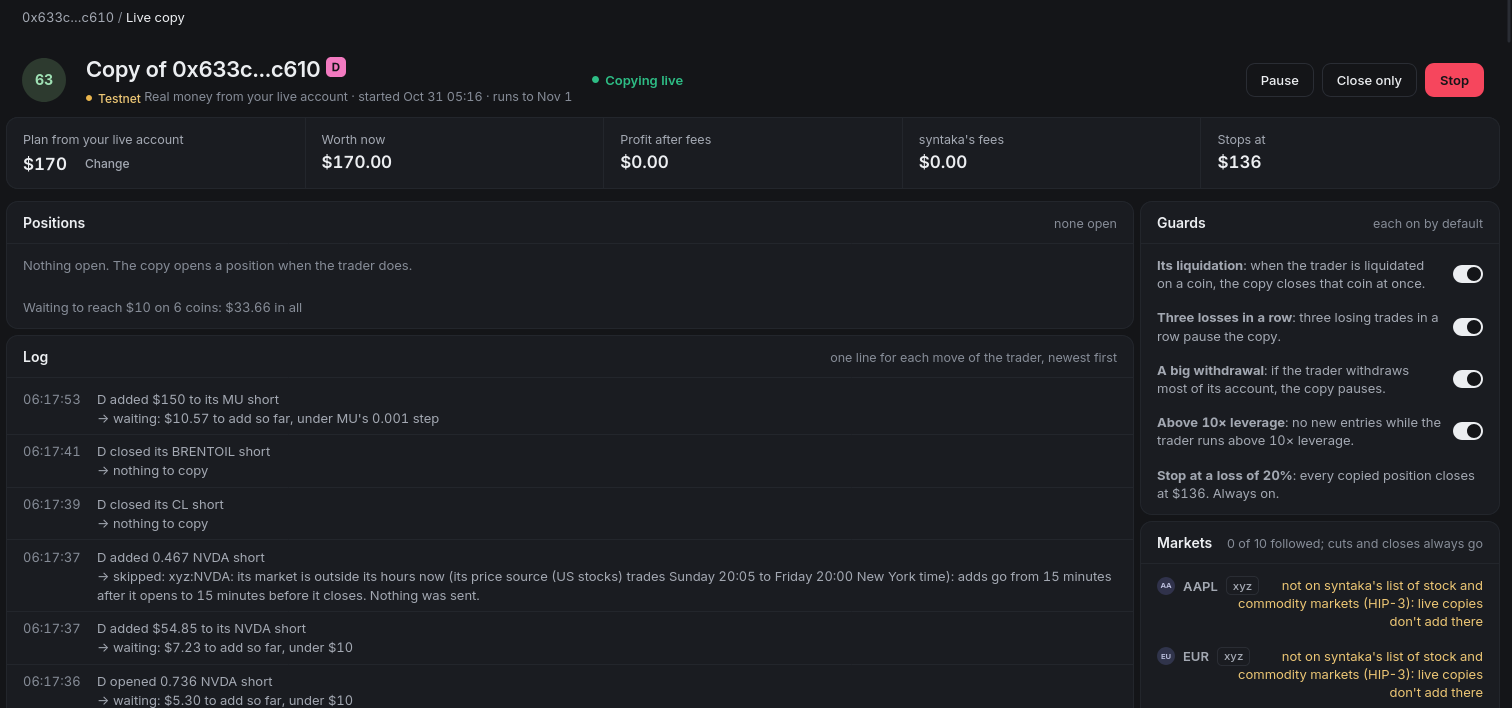
Outside the hours, the log says why, for example: "skipped: xyz:NVDA: its market is outside its hours now (its price source (US stocks) trades Sunday 20:05 to Friday 20:00 New York time): adds go from 15 minutes after it opens to 15 minutes before it closes. Nothing was sent."
The Markets card
A live copy's page has a Markets card. It lists the markets the trader holds now: first the ones your copy skips, each with why, then the ones it follows. Its head sums it up, for example "all 3 followed" or "0 of 10 followed; cuts and closes always go".
The card checks the market (on a USDC dex, not blocked), the market hours and, once syntaka has read it, your account's mode. The trading, order book and leverage checks run when an add comes, and a skip then shows in the log. A copy on practice money has no Markets card.
Your own orders and Stop
- In the Terminal, a live order that opens or adds goes on any HIP-3 market Hyperliquid has live on a USDC dex, on a unified account, unless syntaka's team blocked it in an incident. You can always close a position or cancel an order there.
- Stop (the kill switch) covers HIP-3 markets too. It cancels your orders on the dexes copies trade on and on those you have traded. With Close all positions at market on, it also closes your HIP-3 positions, even ones you opened on Hyperliquid's site.